



The Container Ship Safety Forum’s largest-ever meeting heard that fire frequency among member fleets rose for a third consecutive year in 2025, even as overall safety metrics improved.
With the wider industry warning that fire risk is set to intensify further as lithium-ion battery volumes climb, the findings underline a widening gap between what operators can measure and what they can control – and the crucial importance of sharing frontline information and best practices to mitigate safety threats.
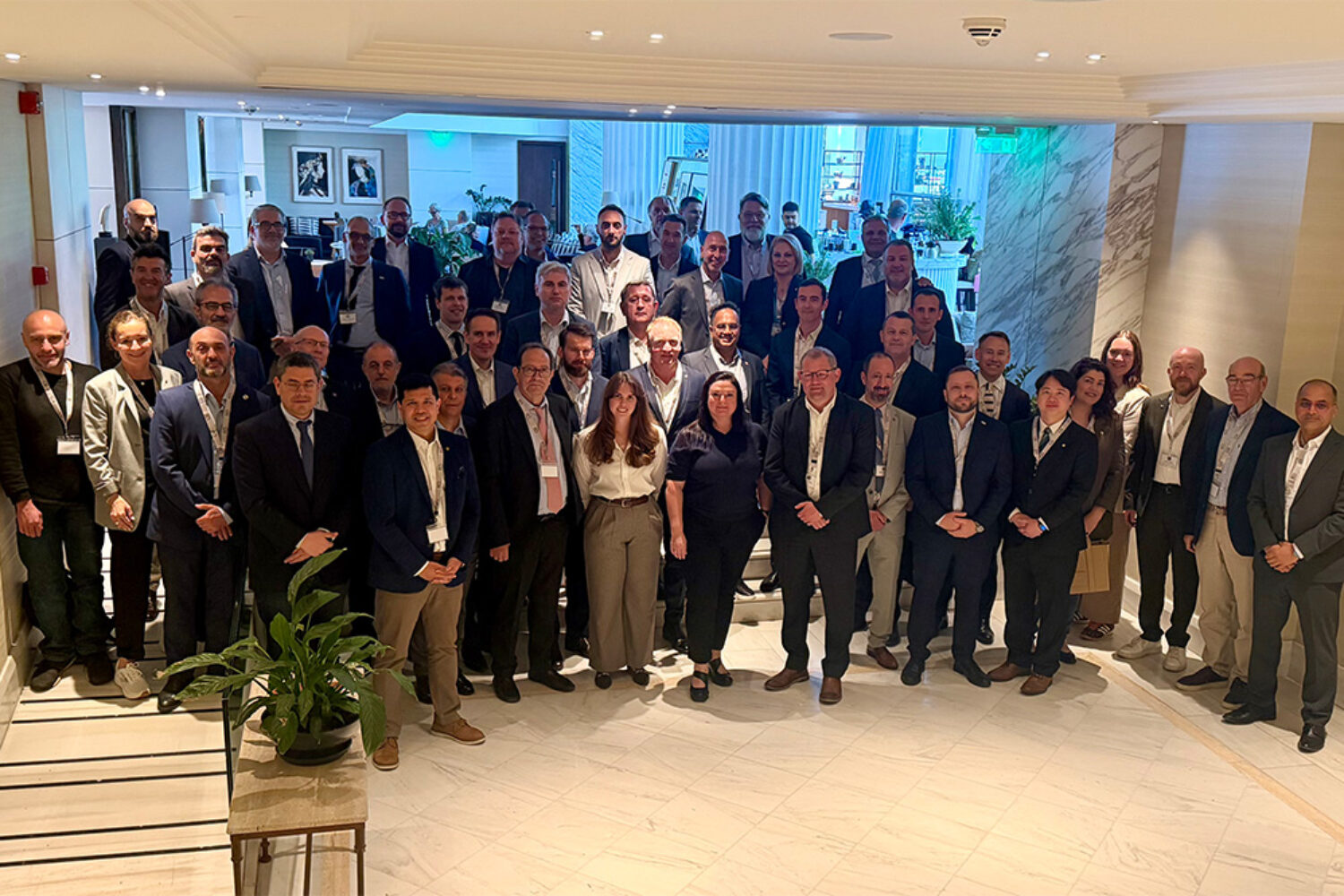
Fire is proving one of container shipping’s most stubborn safety challenges, and the latest data shows the trend still moving in the wrong direction. That was a central message from the Container Ship Safety Forum’s (CSSF) recent members meeting in Athens, which drew more than 60 participants — the largest gathering in the forum’s 12-year history — for two days of presentations and discussion on the industry’s most pressing operational safety challenges.
The CSSF was established in 2014 by a small group of ship owners and managers and currently represents over 50% of worldwide container vessel capacity across its 32 ordinary member companies. CSSF member companies include Maersk, CMA CGM, COSCO, Seaspan, Evergreen, Bernhard Schulte, Columbia, Wan Hai Lines, Costamare, Anglo-Eastern and V.Group to name a few.
A key finding came from the 2025 CSSF Performance Report, presented by Swapnodeep (Swapan) Mondal, Group Managing Director, Operations & Shared Services of Anglo-Eastern Ship Management and second chairman of the CSSF management board: fire frequency among member fleets rose for the third consecutive year, while navigational incident frequency also continued to climb. PSC inspection quality indicators weakened. “These signals highlight the importance of early-warning, risk-sensitive key performance indicators,” said Mondal. “This combination — improving lagging indicators but weakening leading signals — is exactly why KPI relevance and structure matter.”
To put that finding in context, the CSSF measures fire frequency as the number of fire incidents per 1,000 vessel management days — the combined days that members’ vessels spend under their management. On that basis, the fleet-wide average reached 0.15 in 2025, up from 0.14 in 2024 and 0.12 in 2023, marking a third consecutive annual increase from a low of 0.07 in 2022. While it remains below the decade’s peak of 0.17 recorded in 2019, it is the sustained, multi-year direction of travel, rather than any single year’s movement, that has focused members’ attention, pointing to a trend rather than a one-off.
The fleet-wide average also masks considerable variation between individual operators, ranging from those reporting very few incidents to others sitting well above the group average. The spread underlines the differences in exposure and performance across the membership, and the value members place on sharing what works. It is precisely this kind of benchmarking, set against a confidential peer group of comparable operators, that the forum exists to provide.
The data also points to where fires are starting. Under a fire-location breakdown first introduced to CSSF reporting in 2023, which tracks 13 distinct onboard locations, engine and machinery spaces accounted for approximately 43% of all fires recorded in 2025, the single largest share and consistent with 2024 when the same spaces were also the leading location. On-deck fires, both cargo and non-cargo related, together with fires inside accommodation areas, made up much of the remainder. The concentration in engine and machinery spaces is notable because it points to a category of risk where causes such as maintenance, fuel and lubricating systems and early detection sit largely within operators’ own control, in contrast to the separate and persistent challenge of cargo-related fires, where the root causes often lie further upstream in the supply chain.
The data landed against an improving backdrop on traditional safety metrics, including lost time injury frequency and total recordable case frequency both continuing to fall, and detention numbers improving. But the fire and navigation trends dominated the room.
The fire problem: scale, complexity and the limits of training
Several sessions addressed cargo fires directly, and the picture that emerged was one of a risk the industry is still working hard to stay ahead of. Elias Psyllos, Vice President of T&T Salvage, put it plainly: identifying where a fire has started on a large container ship can be “almost impossible” given the thousands of boxes involved. “As reported by the International Group of P&I Clubs that use their own dataset and scope, with fires happening around every ten days, fire containment and crew training are paramount,” he said, drawing a pointed distinction between standard seafarer training and the capabilities of professional marine firefighters.
Søren Thuen, DPA and Head of Fleet Safety Maersk, and first chairman of the CSSF management board, and colleague Enrico Pangoni, Fleet IoT Solutions Lead, addressed prevention and early detection, describing how Maersk has revisited its catalogue of measures in response to the rise in lithium battery fires. Their presentation included design improvements above regulatory minimums and new work on heat-based early detection, an area that is attracting growing industry interest.
The root cause question — misdeclared cargo — remains a challenge. Lithium-ion batteries embedded in consumer goods continue to enter the container system undeclared, and enforcement remains inconsistent across jurisdictions. Several presenters called for standardised digital cargo declarations as a necessary step forward, with regulatory change at the IMO expected to come too slowly to address the near-term risk trajectory.
AI, geopolitics and the competency gap
Beyond fires, the meeting covered a broad agenda reflecting how rapidly the risk landscape is changing. Olivia Northrop, AI Solutions Architect at ABS, made the case for structured AI adoption in safety management, documentation and operational decision support, arguing the container sector is well positioned to benefit but needs a disciplined, use-case-led approach rather than broad deployment. Swapan Mondal’s separate session on geopolitical and security risk addressed how regional instability and conflict are increasingly translating into direct safety implications through longer routes, extended crew time at sea and heightened exposure in high-risk areas.
The underlying competency theme ran through multiple sessions. New fuels, larger ships and unfamiliar technologies are arriving faster than the industry can build experience to manage them. “Whether it is new fuels or new technology, the training of people on board and ashore is limited,” said Mondal. “The problems developing now are something we have not experienced. How do we give guidance back? This is a huge challenge.”
What the forum provides
The CSSF now counts over 40 ordinary and associated members, representing more than 50% of worldwide container vessel capacity. Its model — confidential, operator-led peer exchange, with no commercial agenda — is what distinguishes it from broader industry bodies. “Ship operators are seeking solutions to make operations safer. The CSSF offers peer exchange on all matters relevant to safety — and this helps us to make better decisions at a time when the industry faces many challenges,” said Alfred Gomez, Director Marine Standards at Seaspan Ship Management.
Y.S. Hwang, Head of Operations at Evergreen Marine Corp, one of the forum’s newest members, commented, “The openness of the discussions and the practical focus on real operational experience are valued, also when it concerns addressing the challenge of modern container cargo fires. This requires collective awareness and joint action, and that is exactly what the CSSF provides.”
For Søren Thuen, the Athens meeting illustrated both the value of that model and the urgency of the work ahead. “Our focus remains on safety at the front line by sharing real operational experience and cases that demonstrate how preparedness, training and transparency can make a critical difference.
With fire frequency rising for a third consecutive year, navigational incidents also trending upward and a new generation of risks arriving faster than regulation can keep pace, the CSSF’s Athens meeting made one thing clear: the hard work is far from over, and the CSSF community remains committed to sharing frontline information and best practices to mitigate safety threats.