


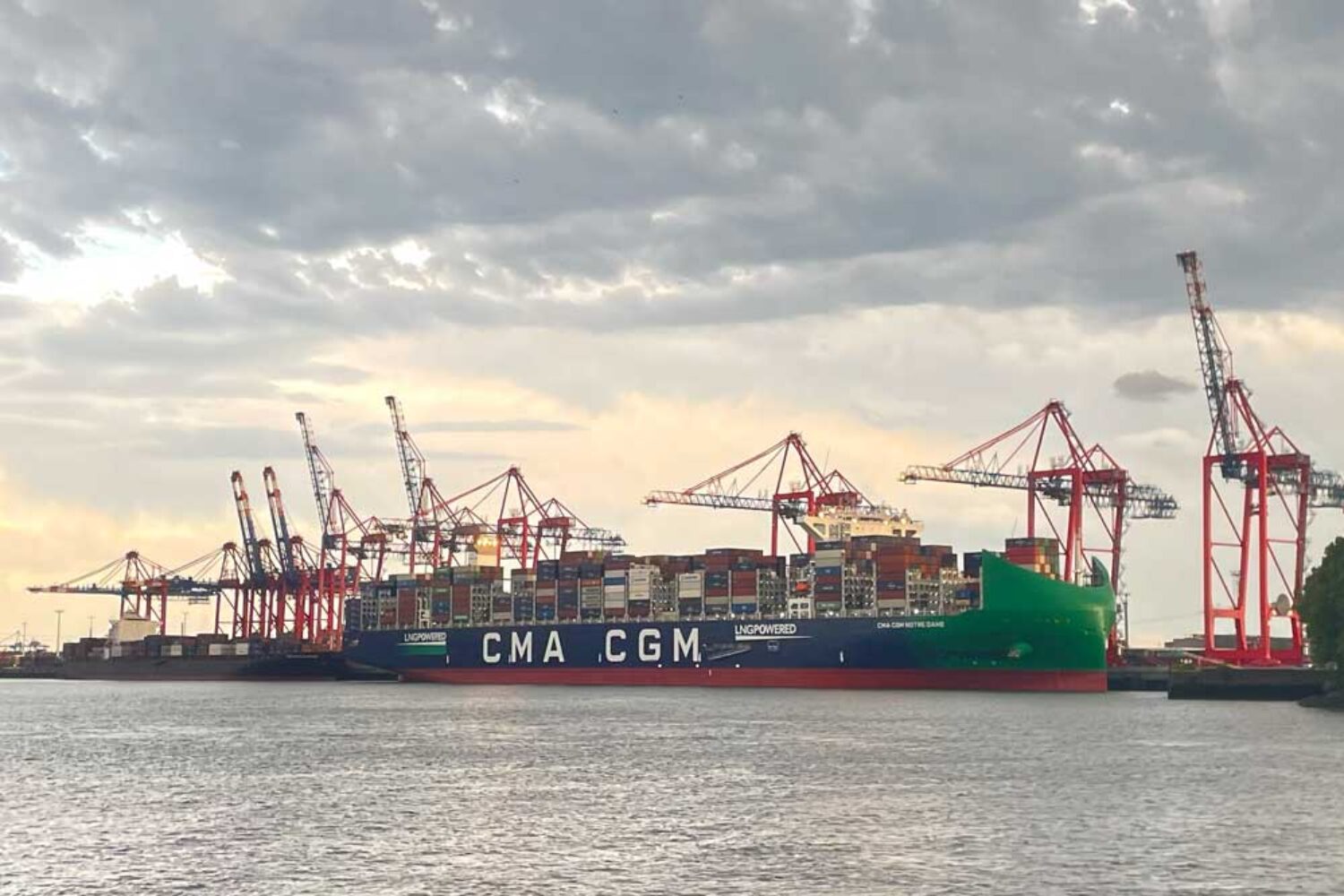
The Port of Hamburg hosted a special visitor this week: the “CMA CGM Notre Dame” – currently the largest container ship flying a European flag. Equipped with an LNG propulsion system, it is also one of the most environmentally friendly container ships in operation.
With a capacity of 24,000 TEU, the “CMA CGM Notre Dame” is the largest container ship flying the French flag and also the first in a series of ten newbuilds due to be delivered by 2028. The ship, which is 400 metres long and 62 metres wide, was built at the Chinese shipyard Jiangsu Yangzijiang Shipbuilding Group.
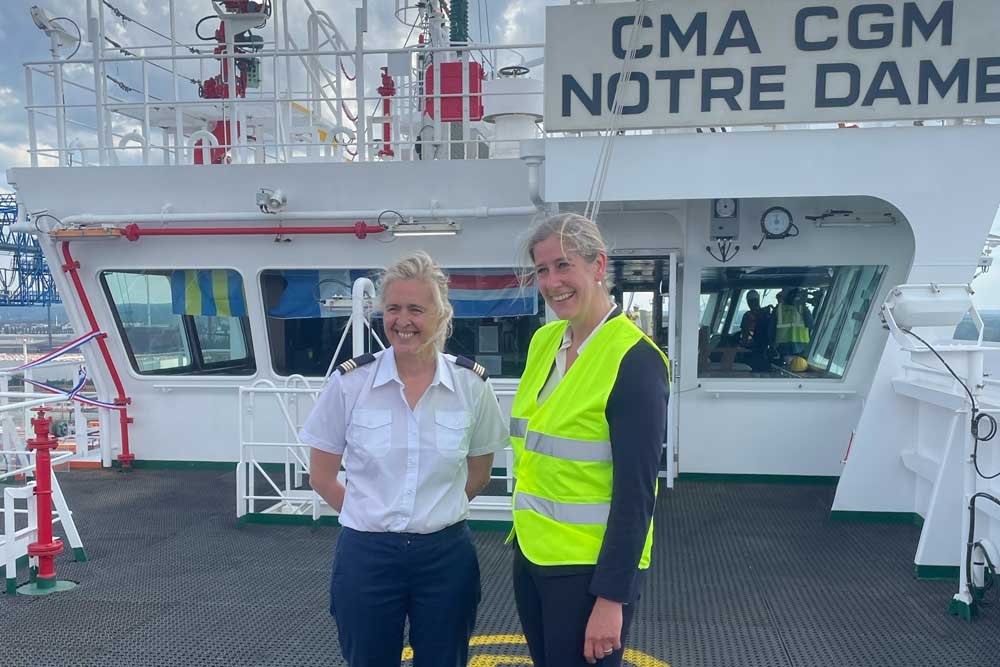
The maximum draught of the “CMA CGM Notre Dame” is 16.5 m. This means the ship cannot call at the Port of Hamburg fully laden, as Captain Marie-Caroline Guillou explains. Before the “CMA CGM Notre Dame” could sail down the Elbe, several rows of containers therefore had to be unloaded at previous ports to enable it to berth at the Eurogate container terminal.
Although Hamburg is limited by tidal conditions and water depth, the captain had praise for the Eurogate terminal. She said the gantry cranes were better than those in Rotterdam because they were taller and could therefore reach every bay more easily.
Marie-Caroline Guillou also praised her own shipping company. She said it was the best shipping company in the world when it came to its carbon footprint. The ship’s main engine is powered primarily by LNG, which is considered more environmentally friendly than marine diesel.
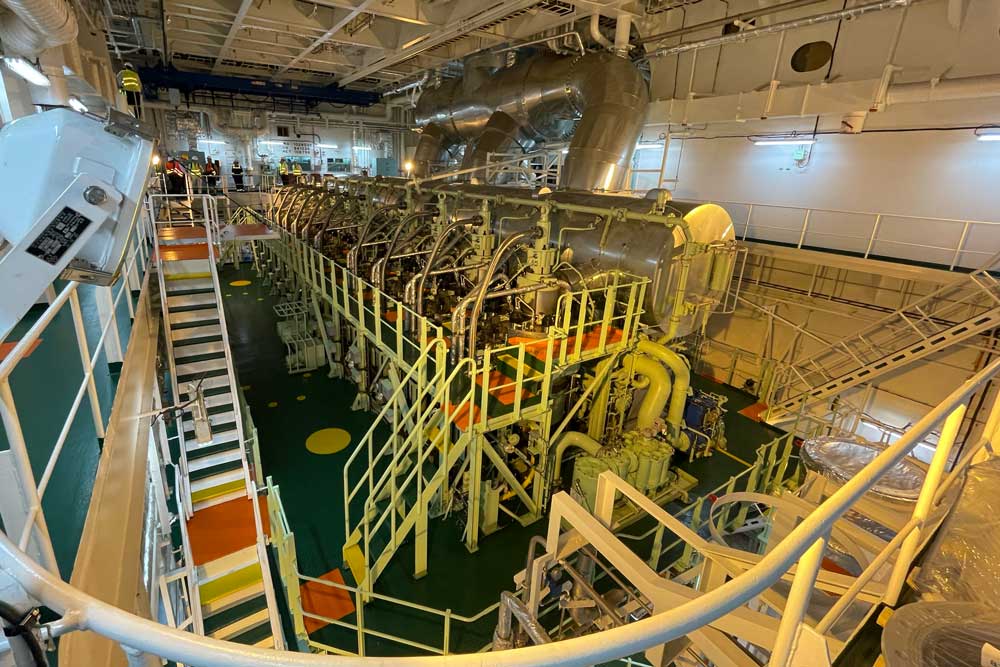
Everllence’s dual-fuel main engine, which is around 30 metres high, has an output of around 90,000 kW and enables a service speed of 21.55 knots. However, as the ship is designed to run on LNG, it is equipped with more auxiliary equipment. According to the captain, this not only means more technical equipment on board, but also requires additional engineering staff. Including her, the crew comprises 32 members.
Bad weather, bad for LNG
An LNG propulsion system also means that greater consideration must be given to the weather, reports the captain. She and her crew are in constant contact with the weather stations operated by CMA CGM around the world. If a bad-weather front is building up anywhere, the “CMA CGM Notre Dame” must navigate around it. The reason for this is the liquefied natural gas in the tanks, which must not be allowed to slosh about and thereby pose a hazard.
However, dangers lurk for the ship not only on board, but also along its route. When the “CMA CGM Notre Dame” leaves the Port of Hamburg tomorrow, it will head for Asia via the Mediterranean Sea and the Suez Canal.
The situation in the waterway between the Mediterranean and the Red Sea remains tense. To ensure the “CMA CGM Notre Dame” can pass safely through the canal, it will be escorted by the French Navy. With its AIS signal switched off, the ship will be manoeuvred through the Suez Canal virtually like a ghost ship before it can continue its journey to Ningbo, Shanghai, Yantian and Singapore.
The “CMA CGM Notre Dame” was christened on 2 July 2026 in Le Havre, France, and entered regular service between Asia and Northern Europe. The FAL is one of CMA CGM’s most important Asia–Europe services and, as part of a roughly 105-day rotation, connects the ports of Ningbo, Shanghai, Yantian, Singapore, Le Havre, Rotterdam, Hamburg and Tanger Med.