




In order to provide better support to the Bundeswehr and NATO, a total of around €1.35 billion is being invested in Bremerhaven. The state’s civilian infrastructure is also set to benefit from the planned “Deployment Hub“.
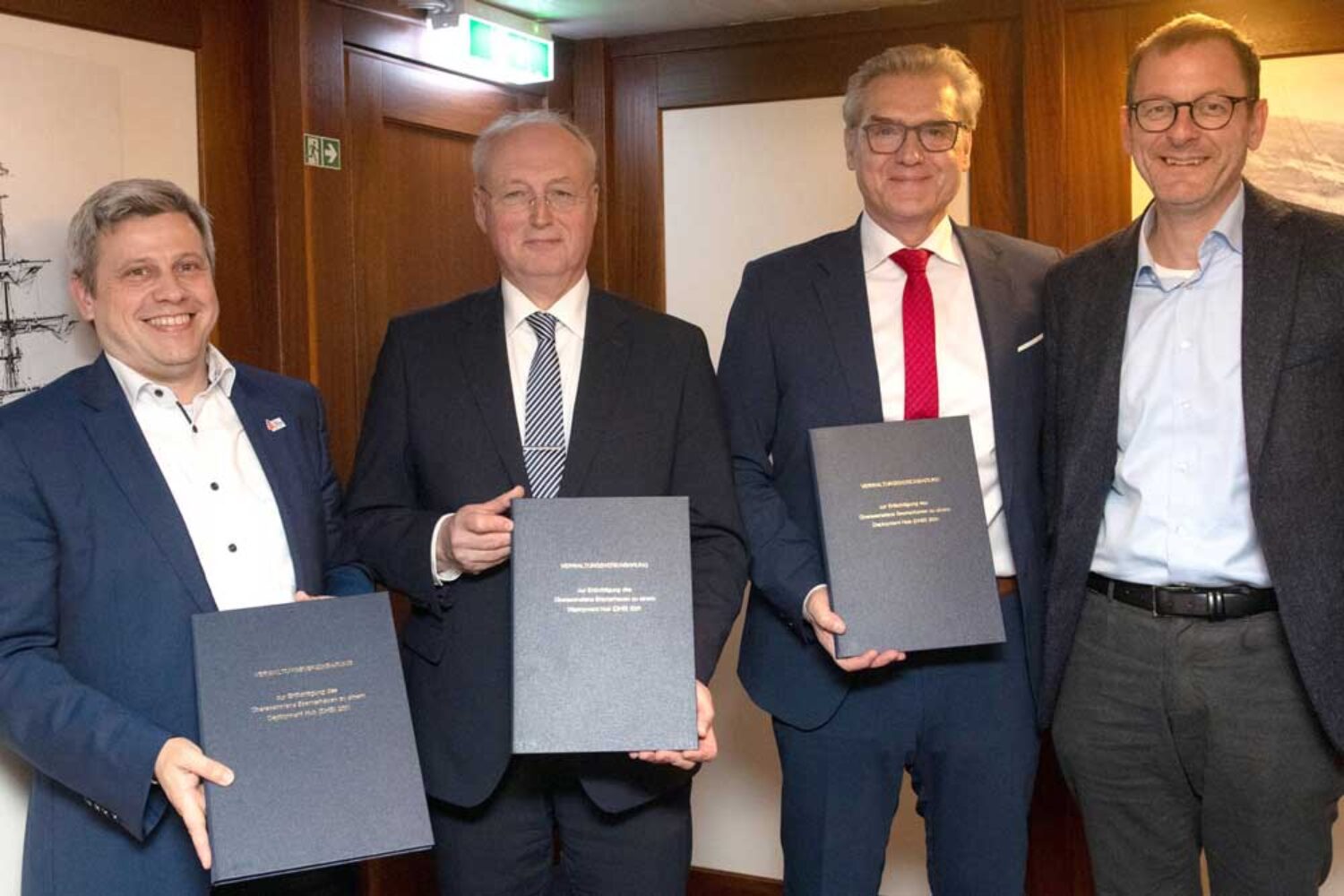
Back in late September, Federal Minister of Defence Boris Pistorius, Bremen’s Mayor Andreas Bovenschulte and Matthias Magnor, Chief Executive of the BLG Logistics Group, signed a corresponding letter of intent. This has now been followed by the administrative agreement and the first individual contracts. The signatories were Roland Börger, President of the Federal Office for Infrastructure, Environmental Protection and Services of the Bundeswehr (BAIUDBw); Thomas Ehmke, Head of the Bremen Senate Chancellery; and Robert Howe, Managing Director of the port management company Bremenports.
These contracts mark the official launch of the major “Deployment Hub Bremerhaven 2031” (DHB31) project. A significant proportion of the planned measures can now be implemented. According to a statement from Bremenports, the €1.35 billion project aims to strengthen the infrastructure and superstructure around the ports of Bremen. The objective is to improve the logistical conditions for the Bundeswehr and NATO. Both the port and hinterland infrastructure are set to benefit; the measures are planned mainly around the ports, but also in Bremerhaven itself and at Bremen Airport. As the project’s name suggests, completion is scheduled for 2031.
Defence and civilian benefits
The BAIUDBw plays a central role in this. As the Bundeswehr’s designated contractual partner, the Federal Office is responsible for implementing the measures in collaboration with Bremen and Bremenports. The individual projects have been intensively coordinated between the parties involved over the past few months. The port management company Bremenports has been commissioned by the Bremen Senate to implement the individual infrastructure and superstructure measures agreed with the federal government. The BLG Logistics Group is to provide the logistical services on site as part of the DHB31 project.
“On the basis of the discussions we held in the run-up to the project with the Senate representatives and the port management company Bremenports, a very effective partnership has developed,” said BAIUDBw President Börger. “Together, we have been able to develop and coordinate numerous infrastructure projects. Precisely because these are civil-military projects, the investments under the DHB31 project are particularly value-adding: we are thereby strengthening our defence capabilities whilst simultaneously creating added value for the civilian use of the existing infrastructure.”
Kristina Vogt, Senator for Economic Affairs, Ports and Transformation in Bremen, added: “In concrete terms, ‘dual-use’ means here that the container quay is being refurbished, the Kaiserhafen is being almost entirely rebuilt, and the Speckenbüttel port railway station is being expanded. This serves both state and alliance defence whilst also making Bremen’s ports more efficient. Civilian use has been taken into account from the outset and is expressly intended. The ports of Bremerhaven will not become a closed-off military site. This is very good news for our port as a business location, as Bremen could not have managed a project of this scale on its own.”
Thomas Ehmke, Head of the Bremen Senate Chancellery, described the investment as a strong signal for Bremen. “By upgrading the infrastructure, we are creating the necessary conditions to meet military requirements whilst at the same time enabling sustainable civilian use,” he said. “It is now a matter of implementing the numerous individual measures swiftly. This is a major task for all those involved. Our common goal must be to organise the necessary planning and approval procedures as efficiently as possible and bring them to a swift conclusion.”
“A monumental task”
Bremenports Managing Director Robert Howe sees the signing of the contracts primarily as the start of a challenging implementation phase: “We are now putting into action what we have prepared and agreed upon together,” he said. “We have an epoch-making task ahead of us, which we approach with respect, but above all with great motivation. These investments give us the opportunity to make the ports more resilient and to raise their infrastructure to a new level. This will benefit both civilian use in Bremerhaven as an economic and port hub and our country’s defence capabilities.”