




Amid a period of geopolitical crises, wars and ‘claims’, the Arctic North-East Passage appears to be enjoying a resurgence in popularity. There is talk of a record year in 2025 – albeit driven primarily by Russia and China.
In 2025, a record of 103 transit voyages was set on the Northeast Passage, according to the Danish Shipping Association. The organisation had itself commissioned an analysis of shipping traffic along Russia’s northern coast.
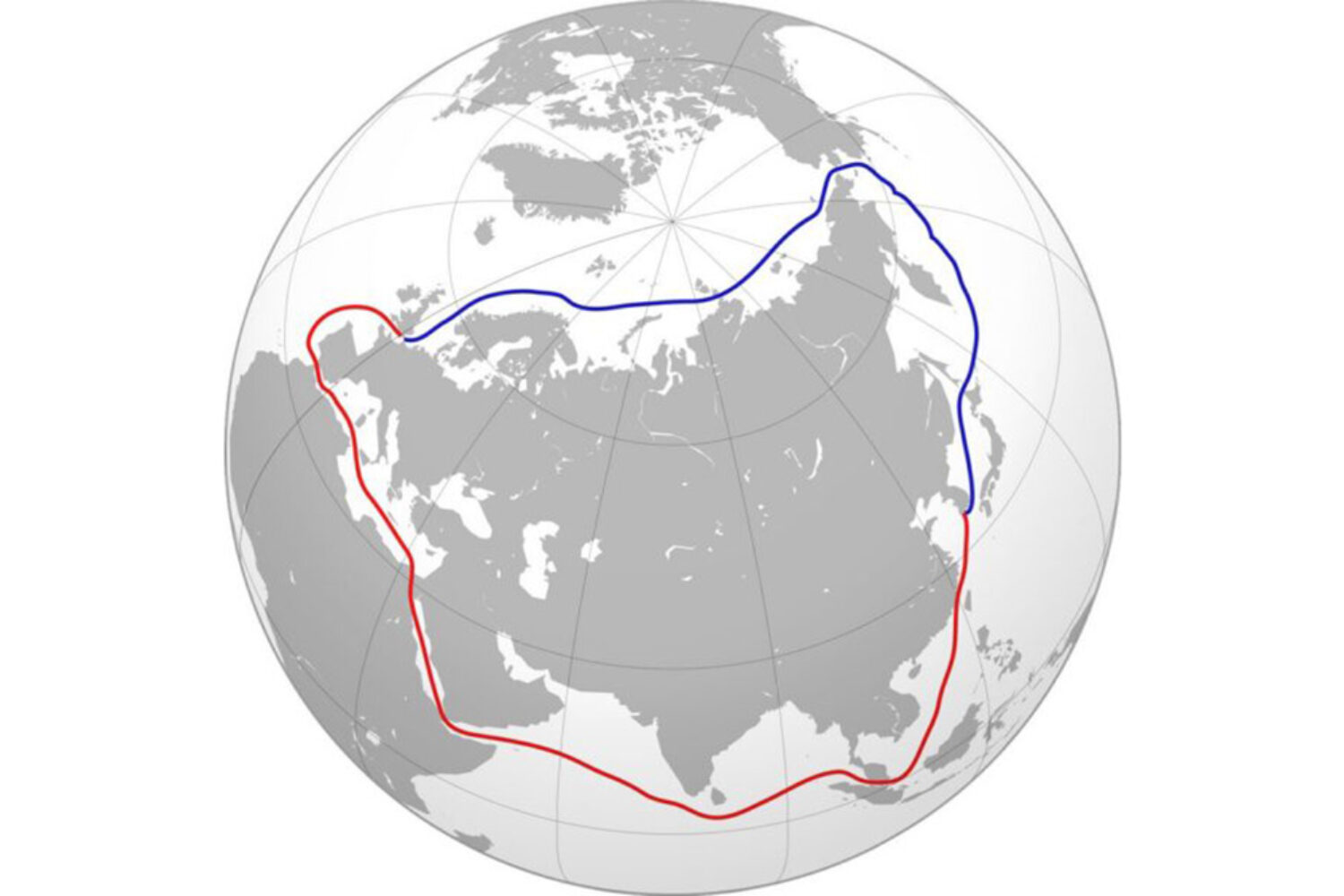
It has been said for years that the melting of Arctic ice could open up a new and significantly shorter shipping route between Europe and Asia. This prospect has long been a source of interest for researchers, governments and shipping companies worldwide. Consequently, some countries have high hopes for the route – whether in terms of transit fees and the logistics of raw materials (Russia) or shorter transport routes (China, South Korea and many others). Whilst some see great opportunities in this, others warn of risks to safety, the climate and the environment.
The analysis shows that 2025 was a record year for transit traffic along the Northern Sea Route (NSR), with 103 registered transit voyages. The number of transit voyages rose by around 6% compared with 2024, whilst the volume transported increased by approximately 3%. However, these appear to be primarily shipments to and from ports in the region rather than genuine ‘passages’.
“We are seeing increasing maritime activity along the Northern Sea Route. However, in terms of volume, it is still a long way from matching the major international shipping routes,” said Jacob K. Clasen, Deputy Managing Director of Danish Shipping, on the occasion of the publication of the results. If one also takes into account that the vast majority of shipping traffic is to or from Russian ports, the conclusion is: “The significance of the Northeast Passage for international shipping is very low today and will remain so for the foreseeable future. Traffic in 2025 was characterised by Russian-Chinese flows of goods, in particular crude oil, petroleum products, coal and other bulk commodities. The vessels called at almost exclusively Russian and Chinese ports. Furthermore, a number of these transits were ballast voyages without cargo.
Although activity on the NSR is increasing, the level remains modest compared with established global trade routes. By way of comparison, more than 2,000 deep-sea cargo ships pass the Cape of Good Hope every month. This means that the record volume of traffic on the NSR in 2025 is roughly equivalent to one and a half days’ worth of shipping traffic at the Cape of Good Hope.
The Northern Sea Route (NSR) is the section of the Northeast Passage under Russian administration – the entire shipping route between the Atlantic and the Pacific that runs along the Arctic coasts of Europe and Russia. The route shortens the distance between Europe and Asia, but requires a Russian permit and continues to be characterised by ice conditions, a short navigation season, and shallow straits and passages, which restrict its use by the largest types of vessel.