





Germany’s merchant fleet remains the seventh largest in the world despite persistently difficult market conditions, the German Shipowners’ Association announced at its annual press conference today. The situation in the Gulf region remains tense.
According to the German Shipowners’ Association (VDR), geopolitical tensions are currently increasing the risks for merchant shipping not only in the Middle East, but on several key sea trade routes at the same time. In addition to the Gulf region, the Red Sea, the Black Sea, the Baltic Sea and important trade routes in the Indo-Pacific are also affected.
Attacks in the Persian Gulf with fatalities and injuries
Nevertheless, the situation in the Gulf region is currently particularly tense. Since the start of the Iran war at the end of February, more than 2,000 merchant ships with around 20,000 seafarers have been stranded in the Persian Gulf, including at least 50 ships from ten German shipping companies with around 1,000 seafarers on board. The only way out of the Persian Gulf is through the Strait of Hormuz, which is currently unsafe to pass through. Around 25 merchant ships have already been attacked, resulting in deaths and injuries among seafarers.
“The Iran war shows us how closely geopolitical conflicts and global supply chains are linked. Around two thirds of our foreign trade is conducted by sea. For an export nation like Germany in particular, the protection of merchant shipping is therefore of strategic importance. Our thoughts are currently with the seafarers who are working under difficult conditions,” said VDR President Gaby Bornheim. More attacks can also be expected in the Red Sea due to the close ties between Iran and the Yemeni Houthi militias
“The German government is understandably weighing up possible measures very carefully in the current situation. Nevertheless, the fundamental question arises as to the importance of protecting free and secure sea trade routes as well as shipping and its crews for Germany. For us it is clear: it is high,” added Martin Kröger, Managing Director of the VDR. The supply situation on German ships is good, given the circumstances. According to the association, the ships could be reasonably supplied over land.
Germany’s merchant fleet in 7th place
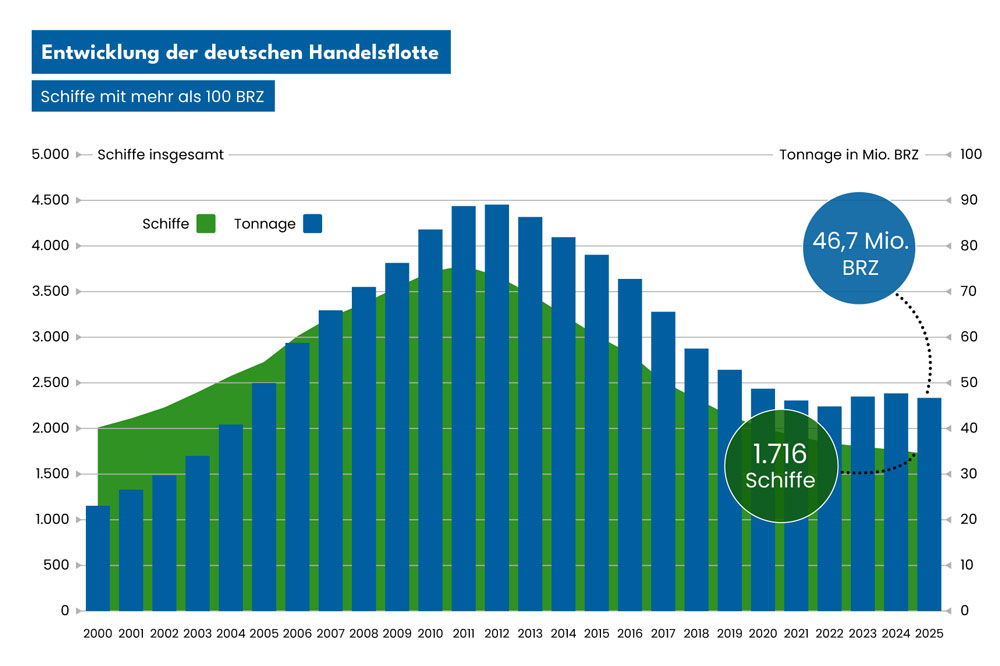
According to the VDR, Germany remains one of the world’s leading shipping nations. The German merchant fleet currently comprises 1,716 ships with a gross tonnage (GT) of 46.7 million, making it the seventh largest merchant fleet in the world by international standards – behind Greece and China, among others.
Germany has traditionally been particularly strong in container shipping. With 30.4 million GT, the German container fleet has moved up from third to second place worldwide, overtaking China with 30.2 million GT. Only Switzerland remains ahead with 41.2 million GT.
“Germany has a strategic treasure with its merchant fleet,” emphasizes Kröger. “It secures the supply of the economy and population and, if necessary, also enables military reinforcement and supply transports as well as humanitarian missions.”
Growing number of new recruits
The VDR also reported positive developments in recruitment, with the number of new entrants at sea rising from 418 to 537 since 2023 – an increase of almost 30%. At the same time, this is the highest figure since 2012; this includes in particular the nautical and technical officer careers as well as training as a ship mechanic, according to the association. In contrast, the number of new entrants to the shipping clerk apprenticeship program fell slightly from 214 to 206.
“The number of new recruits is developing positively, which is very good news. This development shows that more and more young people are recognizing the opportunities offered by careers in the shipping industry,” says Bornheim. “This is a strong signal for the future of our maritime location.”
In view of the growing geopolitical risks, Germany needs an even larger national personnel base in the long term in order to ensure the operational capability of the merchant fleet even in extraordinary crisis situations. The VDR is therefore proposing to enable maritime service in merchant shipping as part of the new military service.