


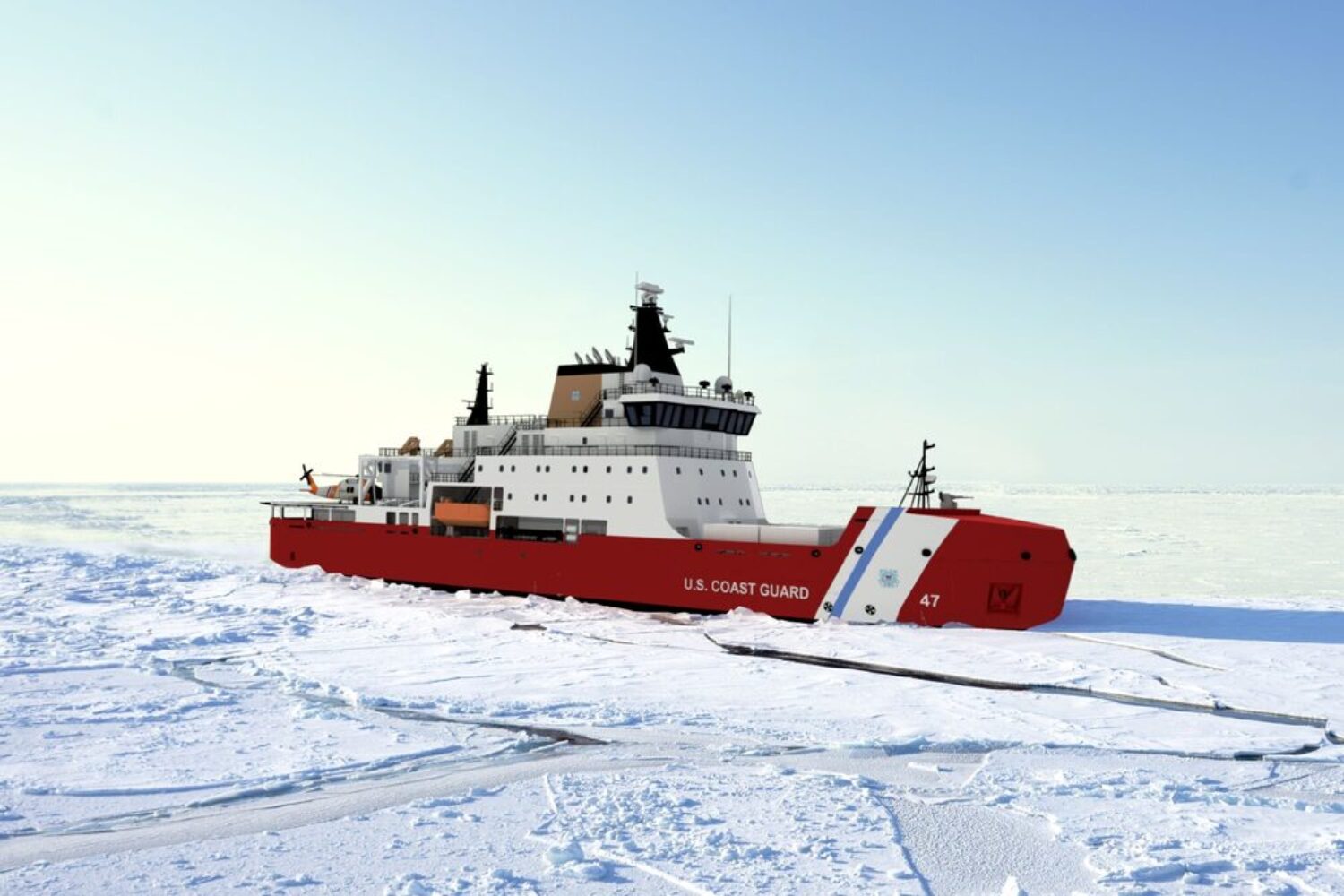
The US Coast Guard has now awarded two contracts for the construction of up to six Arctic Security Cutters (ASC). The new vessels are intended to significantly expand the US’s operational capabilities in the increasingly important Arctic region.
The contractors are the Finnish shipyard Rauma Marine Constructions Oy and Bollinger Shipyards Lockport from the US state of Louisiana. The program is part of a comprehensive security and industrial policy initiative by the US government.
The ASCs are designed as powerful icebreakers for use in extreme Arctic conditions. They are intended to safeguard US sovereignty, keep critical shipping routes open and protect access to energy and raw material resources. The ships are also intended for tasks such as border security off Alaska, supporting maritime trade and deployments in crisis and emergency situations.
According to current plans, up to two units will be built in Finland. Delivery of the first ship built there is scheduled for 2028. In parallel, up to four Arctic Security Cutters are to be built in the USA, with a planned first delivery in 2029. In the short term, the Coast Guard is relying on Finland’s many years of expertise in icebreaker construction, while in the medium term, a transfer of know-how and the expansion of corresponding capabilities in the United States are planned.
“The Arctic Security Cutter is one of the most important and time-sensitive shipbuilding programs in the history of the U.S. Coast Guard, and today’s contract award is a clear sign of confidence in Bollinger’s employees,” said Ben Bordelon, President and CEO of Bollinger Shipyards. “The program is Bollinger’s fifth class of patrol boats for the Coast Guard and builds on our existing Sentinel and Polar Security Cutter programs as well as our 40-plus years of experience delivering more than 187 patrol boats for the Coast Guard,” Bordelon continued.
The newbuildings are part of the “Force Design 2028” modernization program, which aims to further develop the US Coast Guard in terms of structure and equipment. The aim is to make the fleet as a whole more powerful, more flexible and faster to deploy – particularly in strategically sensitive regions such as the Arctic, whose geopolitical importance continues to grow