


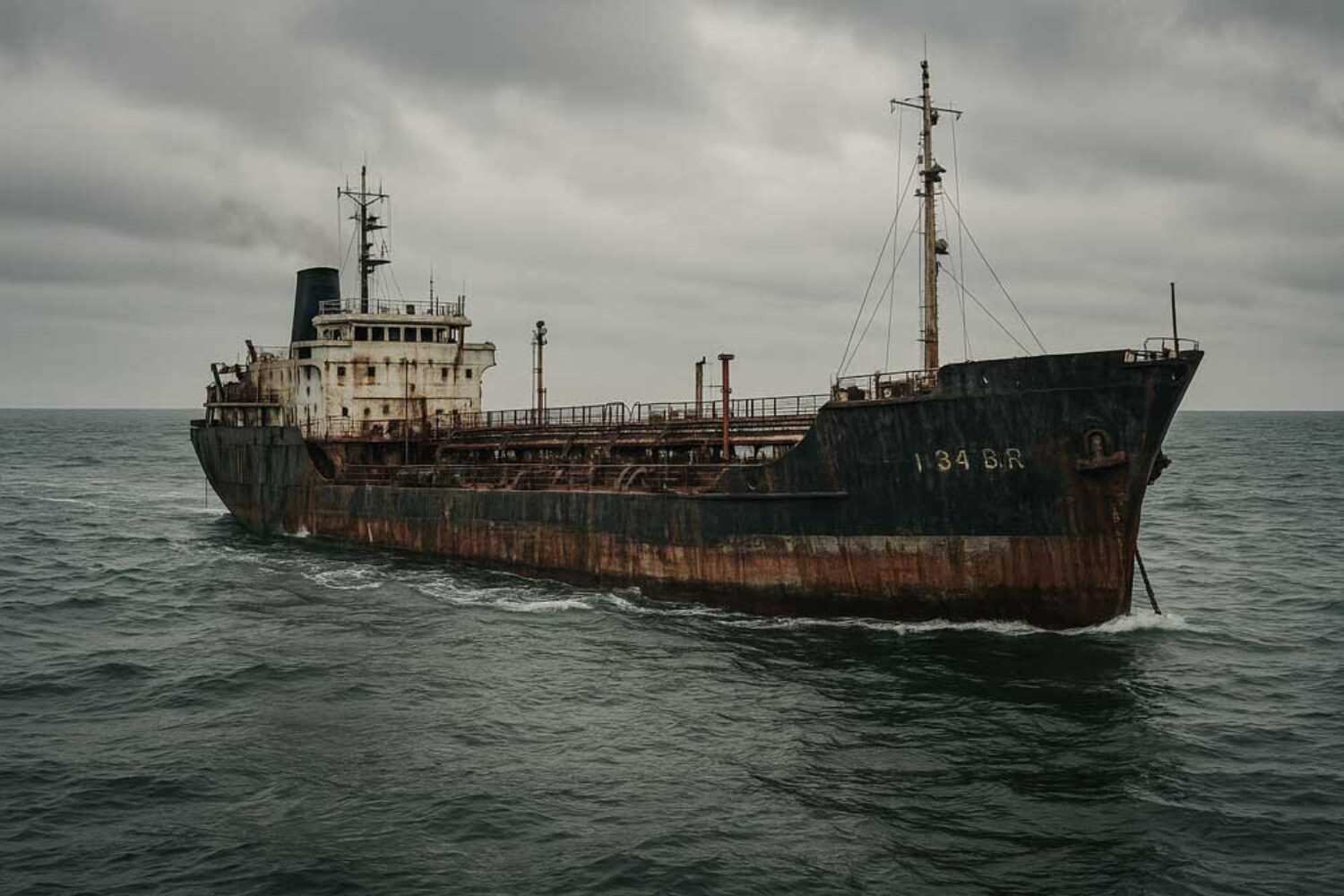
In the first nine months of this year, around 113 ships transported Russian oil under false flags. The most frequently used false flag is the Malawi flag.
This is what the Helsinki-based institute “Centre for Research on Energy and Clean Air” (CREA) found out and published in its latest report. According to CREA, the number of ships in the so-called shadow fleet flying false flags in EU waters is increasing rapidly. On October 1 alone, when the French Navy detained the oil tanker “Boracay” for flying a false flag and suspected of having launched drones to Denmark, at least five more false-flagged ships are said to have been in EU waters. This points to a new normal for Russian “shadow fleet” vessels, according to CREA.
Number increased six-fold since the end of 2024
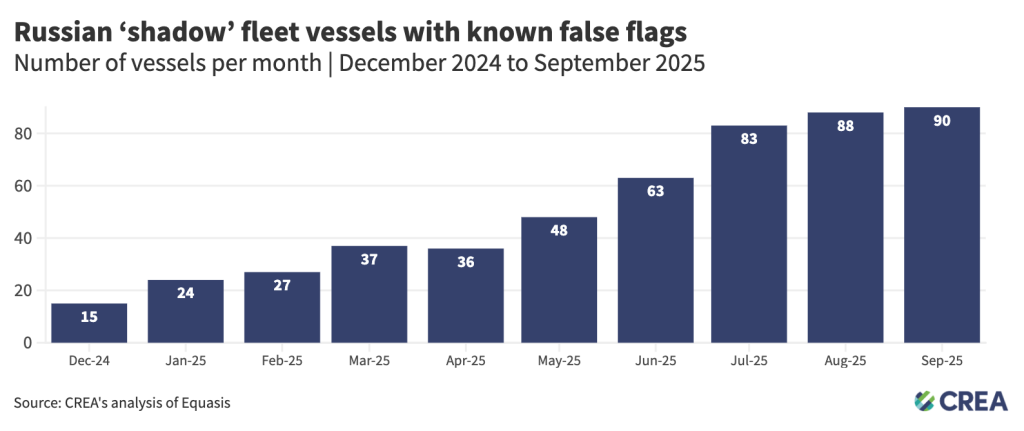
The report shows that in September 2025, a total of 90 Russian “shadow” vessels were sailing under false flags – a six-fold increase compared to December 2024. According to the report, a total of 113 Russian “shadow” vessels have flown a false flag during their operations in the first three quarters of 2025, transporting 13 percent of all Russian crude oil – 11 million tons worth 4.7 billion euros.
The report examines this growing trend of false flagging and also analyzes other changing patterns of the Russian “shadow fleet”, including the emergence of new registers with no maritime history and the behavior of ships sanctioned by the EU, the UK or the Office of Foreign Assets Control (OFAC).
False flagging and frequent flag changes remain the most common methods of sanctioned vessels. By the end of September 2025, a total of 96 sanctioned ships had flown a false flag at least once. 85 ships have changed flag at least twice within six months of being sanctioned by the EU, OFAC or the UK. According to CREA, this points to a new market of operators willing to take the risks of flagging such vessels as traditional registries retreat.
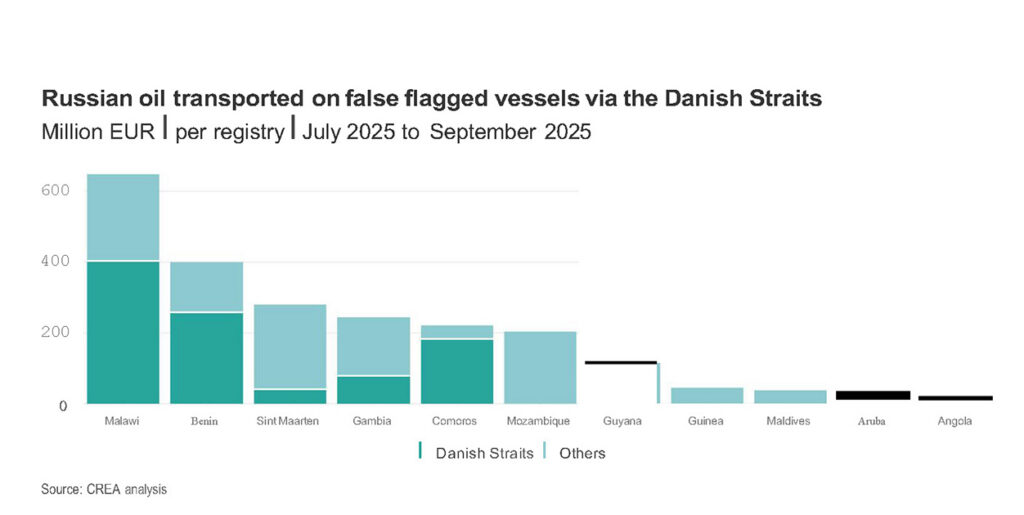
The most commonly used false flag is the Malawi flag. The first such case occurred in June 2025, and since then 24 vessels have transported Russian oil under the Malawi flag. Each of these ships is under sanctions.
Increasing risk of accidents and environmental pollution
Six flag registers, which had not flagged a single Russian oil vessel before the start of the large-scale Russian attack on Ukraine, each had at least ten such vessels in their fleets in September 2025. These six registries currently flag a total of 162 “shadow” ships.
“The number of Russian ‘shadow’ tankers sailing under false flags is now increasing at an alarming rate. In September alone, false-flagged ships transported 1.4 billion euros worth of Russian crude oil and oil products through the Danish Straits,” says Luke Wickenden, energy analyst and co-author of the report. “The insurance of any ship flying a false flag is invalid. Combined with the age of many of these tankers, some of which have almost been reclaimed from the scrapyard, this significantly increases the risk to coastal states along their routes – particularly in the event of accidents or oil spills.”
“In addition to the risks of false flagging, we also see ‘shadow fleet’ operators taking advantage of the limited administrative capacity of economically weak states to use their flags and regulations to obtain passage and delivery rights for ‘blood oil’,” said Vaibhav Raghunandan, CREA EU-Russia analyst and co-author of the report. “The international community must push for reforms in the flag law framework, support capacity building in flag registers and arrest misflagged vessels to curtail the operations of the ‘shadow fleet’ that are helping Russia finance its large-scale invasion of Ukraine.”
CREA calls on EU and UK policy makers to reform flag law regimes and practices worldwide to prevent their abuse by the ‘shadow fleet’ funding Russia’s war on Ukraine.
False flagging violates Article 94 of the United Nations Convention on the Law of the Sea (UNCLOS). Coastal states must act decisively to arrest Russian ‘shadow’ false flag vessels as they pose significant environmental and security risks to European and UK coastlines.
Arresting false flag ‘shadow’ vessels would significantly disrupt Russian oil logistics, increase costs and cause delays – and ultimately reduce the volume and reliability of the Russian oil trade that is funding the war in Ukraine.