

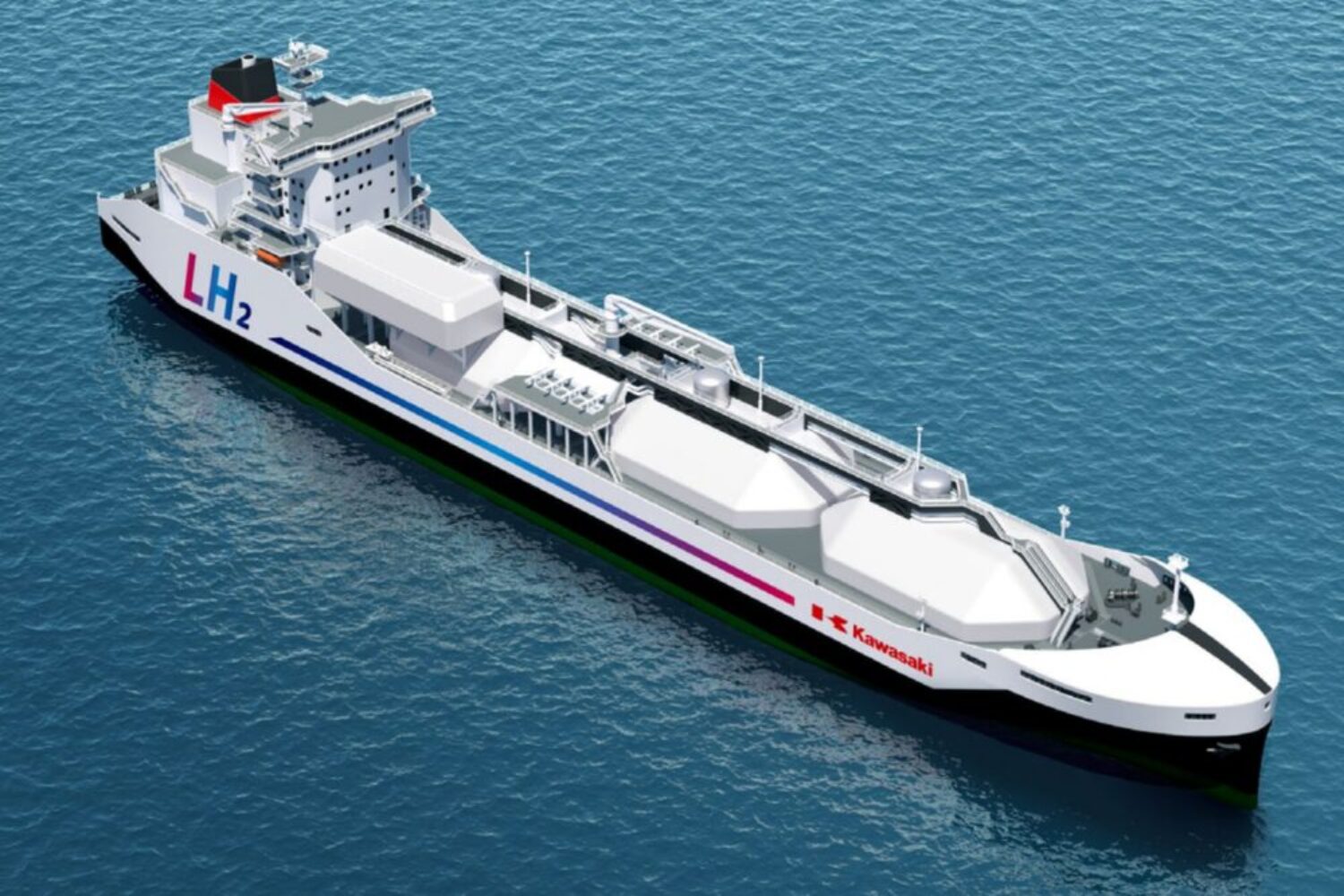
Kawasaki Heavy Industries (KHI) and Japan Suiso Energy (JSE) have signed a contract for the construction of the world’s largest liquid hydrogen (LH2) carrier.
The ship will have a loading capacity of 40,000 m³ and is considered a milestone in the development of a commercial hydrogen supply chain in Japan.
The project is being built at KHI’s Sakaide Works in Kagawa Prefecture. JSE is assuming the role of project operator as part of the Green Innovation Fund project of the Japanese funding organization “Nedo”. The aim is to demonstrate the loading and unloading of liquid hydrogen between ship and terminal as well as operation under deep-sea conditions by the 2030 financial year, according to a joint statement.
Kawasaki had already built the world’s first liquid hydrogen carrier with a capacity of 1,250 m³ in 2021 with the “Suiso Frontier”, pioneering maritime hydrogen transportation. The new 40,000 m³ vessel that has now been commissioned is significantly larger and will form the basis for a future international hydrogen supply chain.
The carrier will be equipped with highly insulated cargo tanks in order to minimize the natural heat input and the associated formation of boil-off gas (BOG). The electric propulsion system combines a conventional diesel-based generator with a hydrogen/oil-based dual-fuel generator. In addition, a gas supply system is provided that makes it possible to use the resulting BOG as fuel and thus reduce CO₂ emissions during transportation.
For cargo handling, a system is designed that can load and unload large quantities of liquid hydrogen safely and efficiently. Double-sheathed, vacuum-insulated pipelines ensure that the extremely low temperatures are maintained. The shape and draught of the ship have been specially adapted to the low density of liquid hydrogen, which reduces power requirements and increases propulsion efficiency. All hydrogen-related systems were subjected to a risk analysis to ensure the safety of the crew, the environment and the ship.
The newbuild is to be used in conjunction with the LH₂ terminal currently under construction in Ogishima (Kawasaki city), among other things. There, JSE wants to demonstrate the performance, safety and cost-effectiveness of the overall system. With this project, Kawasaki and JSE want to make a contribution to the decarbonization of energy generation, industry and mobility and promote the development of a hydrogen-based society.
Technical data:
Length (LoA): 250 m
Width: 35 m
Draft (summer, fully loaded): 8,5 m
Cargo tank capacity: approx. 40,000 m³
Propulsion: diesel/hydrogen-based electric propulsion system
Speed: approx. 18 kn
Classification: ClassNK
Flag: Japan