


The German government has commissioned four new vessels to strengthen its federal maritime capabilities, awarding contracts to shipyards in Spain and Germany.
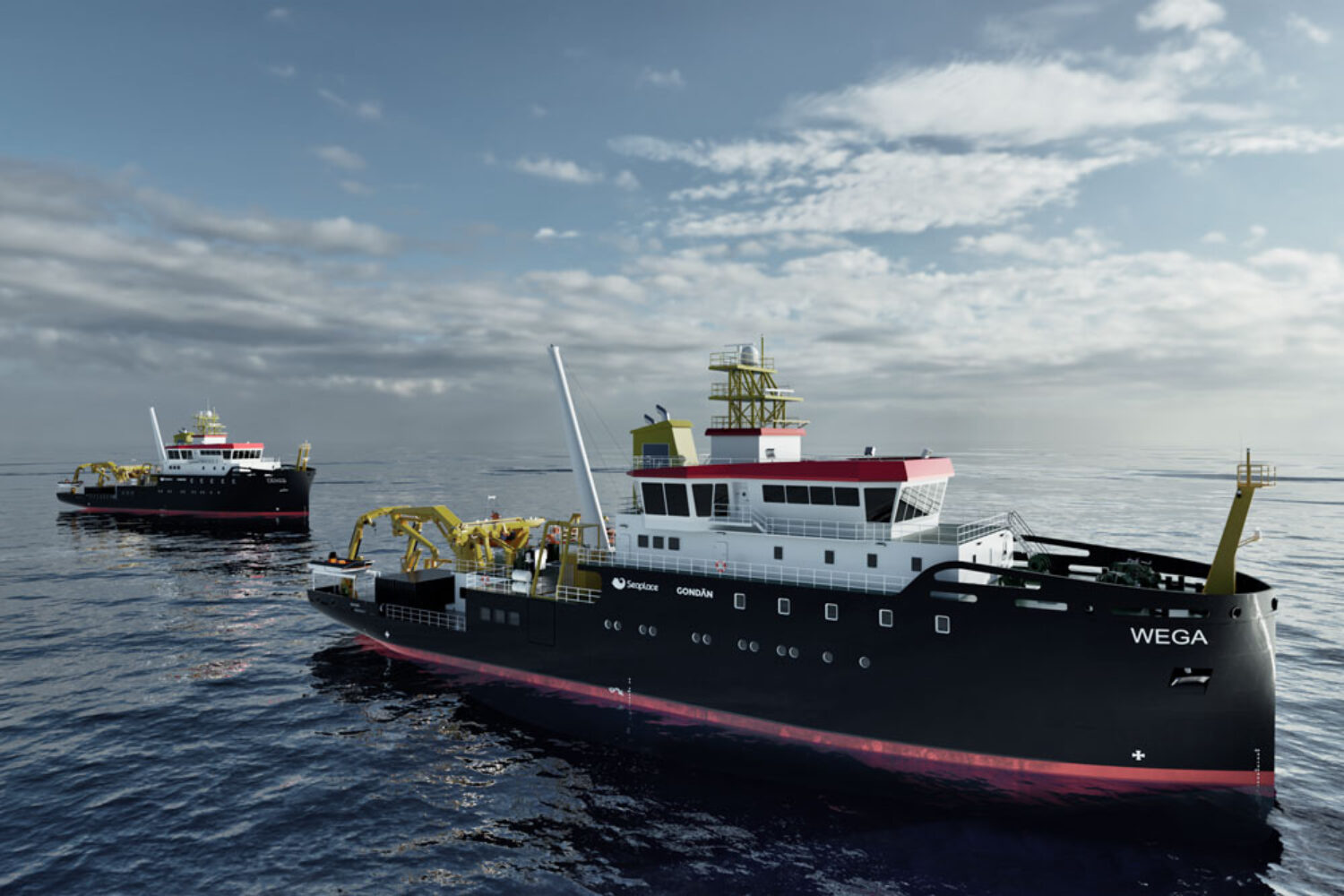
As part of the renewal programme, the Federal Maritime and Hydrographic Agency (BSH) will receive two new multi-purpose ships to replace the current units “Wega” and “Deneb”.
The newbuilds will mainly run on methanol. “The engines are designed for green methanol and reduce CO₂ in the maritime sector,” says BSH President Helge Heegewaldt. Both newbuilds have been awarded the “Blue Angel, UZ-141 for ship design” environmental quality mark.
The ships also meet the “Silent-R” standard of the DNV classification society for research vessels. The low-noise operation is intended to protect marine fauna and enable more precise acoustic measurements. A modern dynamic positioning system will ensure maximum reliability, enabling precise positioning for safe diving operations and the use of remotely operated underwater vehicles (ROV). According to the BSH, this will enable complex underwater work to be carried out efficiently and reliably.
The ships will also be equipped with modern hydrographic equipment, including sensors and measurement technology for surveying the seabed and the water column. In addition, autonomous survey vehicles will be used for the first time, which, according to the BSH, will make hydrographic operations significantly more efficient.
Costs for both newbuilds amount to €270 million
The new “Wega” is scheduled for completion in 2029, with the new “Deneb” to follow a year later. According to the BSH, the Spanish Gondan shipyard impressed with its “economic efficiency and high quality standards” in the tendering process. The company is planning the development of a ship completely digitally and is using innovative technologies such as welding robots. The total costs for both ships amount to €270 million.
The two newbuildings are each 70 m long, 15 m wide and have a draught of 4.2 m. The crew consists of 18 people, and up to seven scientists can also be on board. Like the previous ship, the new “Wega” will be stationed in Hamburg, while the new “Deneb” will have its home port in Rostock. Both newbuilds are designed for a service life of 30 years.
“With the modernization of the fleet, we are ensuring constant operational readiness in the North Sea and Baltic Sea with one ship each as well as the necessary special equipment and an experienced crew,” explains BSH President Helge Heegewaldt. “In the event of accidents, we can quickly investigate underwater obstacles and initiate further measures. Our surveying and oceanographic data collection are also relevant for Germany’s naval defense capability.”
Two new pilot transfer boats for the GDWS
The Federal Waterways and Shipping Administration (GDWS) is also receiving two new vessels. According to a joint press release from the GDWS, BSH and the Federal Ministry of Transport, two SWATH pilot transfer vessels were ordered for the Lotsbetriebsverein e.V. on November 18. This order was placed with the Abeking & Rasmussen shipyard in Lemwerder, Germany. The ships will replace the previous SWATH tenders “Duhnen” and “Döse”. They are due to be delivered at the end of 2027.
The two ships will have a length of 25.63 meters, a width of 14.27 meters and a draught of 2.70 meters. They will be powered by a diesel-electric drive. Two diesel engines will supply energy to electric motors, which in turn will each act on two propellers. The transport capacity of the ships is specified as twelve people (plus crew; additional supplies for the pilot station ships are also possible).
This special design of the small waterplane area twin-hull ships (SWATH) is intended to ensure stable and smooth sailing behavior and provide pilots with an ideal working platform when transferring to large ships during the voyage and in adverse sea conditions. The buoyant volume of the ships is well below the waterline, while the majority of the ship’s structures are above it. This is intended to minimize the relative movement between the vessels when transferring people to other ships, thereby significantly increasing safety and extending the weather window for possible operations.
“For us, the new SWATH tenders are more than just technical projects: they are a promise to the sea pilots who do great things every day. Their special design ensures safety and confidence even in rough weather. I am delighted that the pair of ships will make the important work of piloting a little easier and safer,” says GDWS President Anke Leue.