


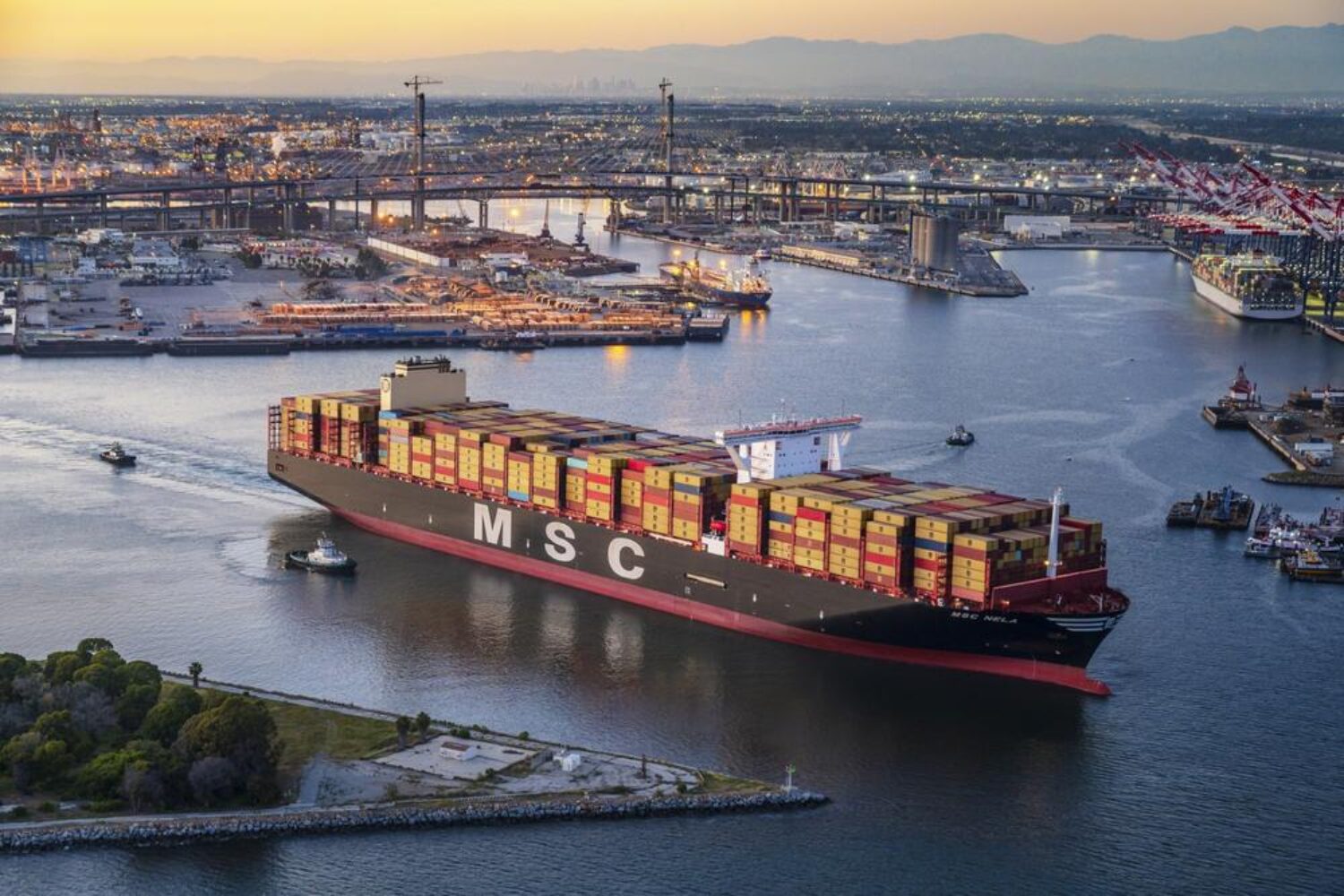
Last year, the fleet of the Mediterranean Shipping Company (MSC) grew by over 800,000 TEU. This means that the gap between the world’s largest shipping company and its competitors continues to grow.
According to new data from industry analyst Alphaliner, the capacity of the liner shipping companies, each of which controls more than 1% of the global fleet, has grown by a total of 2.14 million TEU or 7.3%. The lion’s share is accounted for by MSC: the Swiss company has added a capacity of 831,400 TEU to its fleet, which corresponds to relative growth of 11.7%. Newbuildings alone account for 700,000 TEU: 54 ships were delivered to the company. The Swiss were also more active than average on the second-hand market. The shipping company’s total capacity broke through the 7 million TEU barrier in 2025, and the trend continues to rise.
By comparison, the Danish shipping company Maersk, the closest competitor in the global rankings with 4.6 million TEU, expanded its fleet by “only” 17 newbuilds. Capacity grew by 4.3% or 197,000 TEU. The market leader’s already comfortable lead has therefore grown even further with this development.
In addition to MSC, other shipping companies also grew strongly in proportion. Evergreen expanded its fleet by 10.2% (21 newbuildings, 198,600 TEU) to a total of 1.95 million TEU and thus continues to occupy seventh place on the list. Eighth-placed HMM from South Korea even recorded growth of 12.8%: The fleet increased by eight newbuildings and 131,400 TEU. The fleet of Wan Hai (eleventh place) grew by 9.4%, while PIL, the last of the top 12, increased its capacity by as much as 13.4%.
Yang Ming overtakes Zim
The Israeli shipping company Zim lost its ninth place due to a 10.7% reduction in capacity, while Yang Ming showed moderate growth of 1.5%. The two companies are the only two of the major shipping companies that did not receive any newbuildings last year.
While MSC will maintain first place in the coming years, the analysts at Alphaliner expect Maersk to soon vacate second place due to its relatively low growth. The French shipping company CMA CGM, the third-placed shipping company with 4.13 million TEU, expanded its capacity by 7.5% last year. Maersk’s order book comprises around 1 million TEU, while CMA CGM will increase its fleet by approximately 1.8 million TEU. However, Alphaliner does not expect the French company to overtake Maersk in the current year.
Low net growth at Hapag-Lloyd
“Newbuilding programs provide a good outlook for the expected fleet growth,” Alphaliner said, “but some shipping companies are combining the delivery of new ships with the sale of older ones or the return of chartered ships.”
This was the case for Hapag-Lloyd in 2025. The German shipping company added eight new ships to its fleet with an additional capacity of 102,400 TEU, but the net growth was significantly lower at 58,650 TEU or 2.5%. The Hamburg-based company is pursuing an ambitious modernization course: as recently as December, Hapag-Lloyd ordered eight additional container ships (4,500 TEU), which are to be equipped with dual-fuel propulsion systems and use methanol as fuel.