


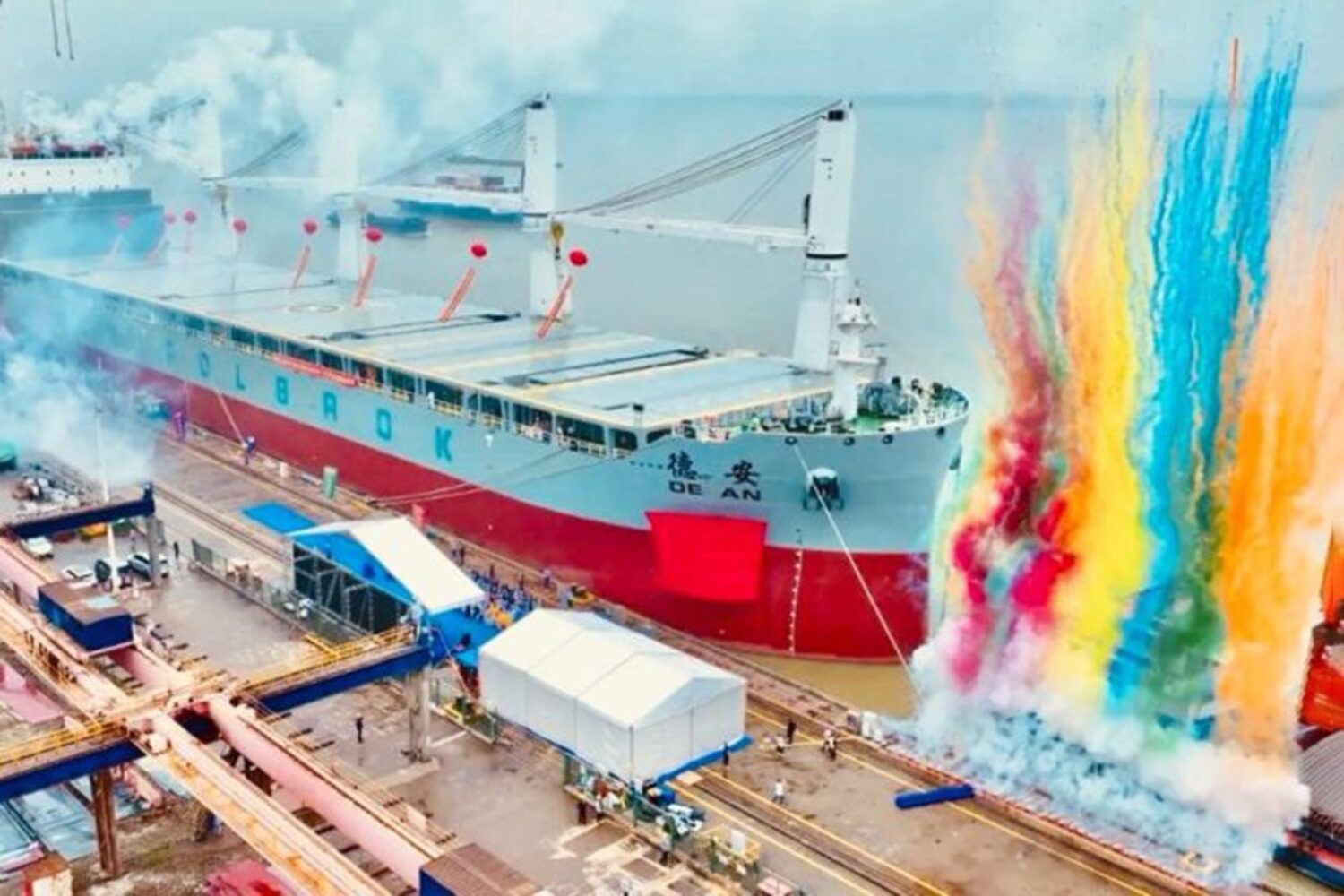
Two heavyweights in MPP shipping, the state-owned Chinese shipping group Cosco and the Chinese-Polish shipping joint venture Chipolbrok, which is also state-controlled, are relying on new large heavy-lifters.
Cosco Shipping Specialized Carriers has ordered four new multi-purpose vessels from the CSSC shipyard in Chengxi. These 40,000 tdw units are to be delivered and put into service from June 2028. Cosco sees this order as response to the increasing demand for transportation for the wind energy sector – and the ever larger wind turbines. According to a stock exchange announcement by the Shanghai-listed company, around $213 million will be invested in this project.
Cosco is one of the heavyweights in the global shipping industry. In the container sector alone, the group operates a fleet of 550 ships, including over 220 of its own. This puts the Chinese company in fourth place in the global market, ahead of the Hamburg-based liner shipping company Hapag-Lloyd. More than 100 units from the heavy-lift, MPP and semi-submersible segments as well as deck carriers and car carriers are bundled in the “Specialized Carriers” division.
Cosco also repeatedly invests in these fleets. The Chinese are increasingly interested in comparatively large ships. Most recently, six 60,000-tonne vessels were ordered in June 2025 and a semi-submersible in March.
Chipolbrok orders 60,800-tonner
Chipolbrok has also been focusing on the “larger” segments for some time now. While the fleet used to focus on ships in the 30,000 tdw range, the focus is now shifting to even larger units. Last summer, for example, the seventh new 62,000 tdw vessel was put into service.
And the Chinese-Polish cooperation is now becoming active again in this size range: according to reports, a total of six 60,800-tdw vessels have been ordered in recent days. The 199 m long ships, each with three 200 t cranes, large cargo holds and a deck strength of 4.5 t/m² as well as the bridge superstructures in the foreship area, will be built by the Taizhou Sanfu shipyard. Delivery planned from Q4 of 2027. This order is also based on the “new” demand from the wind energy sector, according to reports.